Tuesday, April 11, 2023

Samuel N. Patterson House - Xenia, Ohio


 The Samuel N. Patterson House is a historic residence in the city of Xenia, Ohio. Patterson, the owner and architect for this house, was born in Washington, D.C., in 1818. The family moved west to Winchester, Ohio when Samuel was four. As a young man he became a carpenter in Cincinnati, Ohio. In 1846, he moved to Xenia. The next year he married Ellen Newcom; they marriage lasted nearly sixty years before his death in 1907. Soon after his arrival in Xenia, he became an important local businessman. Although he entered into partnership with another man, Tobias Drees, in the ownership of a local mill, he sought to make himself known as a carpenter, and was reputed to be an excellent designer and carver. Patterson arranged for the construction of his house on in 1863. Architectural Style-Italianate. Posted to the National Register of Historic Places on June 3, 1976. GPS: 39.68978°N, -83.93202°W

Sunday, April 9, 2023

Madison County Court House - London, Ohio


Madison County Courthouse in London, Ohio. Built in 1890-1892, and has remained virtually unchanged since it was built. The courthouse was designed by architect C. H. Maetsel, and was built by contractors, Doerzbaeh and Decker. The building was erected at a cost of $209,445. The courthouse rests on a stone foundation, and measures approximately seventy-five feet square. The cornerstone was laid on October 4,1890. Architectural Style-Second Empire. Posted to the National Register of Historic Places on March 14, 1973. GPS: 39.88657°N, -83.44931°W.


Swetland House - London, Ohio


Swetlund House in May 1981


Page copied from the Atlas of Madison County in 1875 showing the Swetland residence

 The Swetland House is a historic residence in London, Ohio, United States. Built in 1871, it is one of the city's leading Italianate houses, and it was once home to one of London's leading citizens. Jeriah Swetland passed through London in 1843 and settled there permanently in 1856. Founding a business with his brother-in-law, he quickly prospered; within a decade, he had become one of the city's richest men. In the late 1860s, he purchased a large tract of undeveloped land southeast of downtown London and platted it for resale; among the houses built in this area was his own, which was completed in 1871. For a time in the late twentieth century, the Swetland House was used as the London Community Arts Center. Posted to the National Register of Historic Places on January 11, 1983. GPS: 39.88920°N, -83.44361°W.

Red Brick Tavern - Lafayette, Ohio


Red Brick Tavern in 1933


Red brick Tavern in 1975

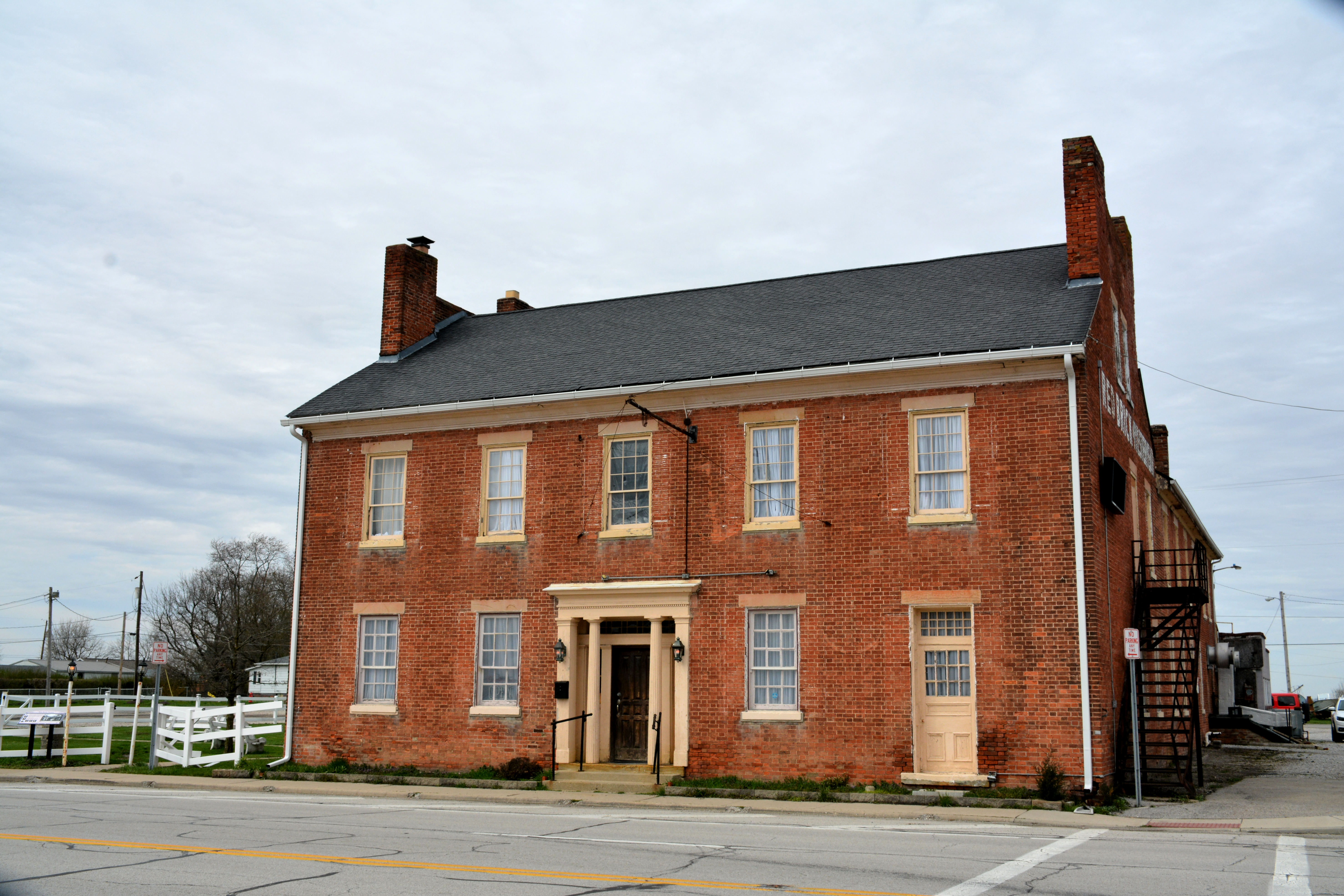
 Red Brick Tavern in Lafayette, Ohio. Located on the National Road (US 40), west of Columbus, Ohio. The Tavern was built in1837. Originally a stagecoach stop, the Red Brick has had a variety of uses throughout its long history. During a portion of the 1800s it was an inn and tavern. Six U.S. presidents stopped there: John Quincy Adams, Martin Van Buren, William Henry Harrison, John Tyler, Zachary Taylor and Warren G. Harding. With the advent of railroads meant that fewer people were traveling along the National Road. As a result, the Red Brick closed in 1859 and was converted into residential housing. From 1854 to 1864, a school also occupied the third floor. It didn’t reopen as a tavern until 1924. It is now the 2nd oldest tavern in Ohio. Its erection marked the completion of the Cumberland Road section through Deer Creek township, Madison County, in 1836-1837. Architectural Style-Federal. Posted to the National Register of Historic Places on September 5, 1975. GPS: 39.93793°N, -83.40679°W.