Wednesday, April 19, 2023

Delaware County Jail and Sheriff's Residence - Delaware, Ohio


Delaware County Jail and Sheriff's residence in Delaware, Ohio. Built in 1878 at a cost of $25,845. It contains 16 cells for men and 2 for women. This 8500 square foot building was used until 1988 when the new facility was built on Route 42. Architect - David W. Gibbs of Toledo, Ohio. Architectural Style-Queen Anne. Posted to the National Register of Historic Places on July 12, 1990. GPS: 40.3018880° N, 83.0687710° W.
 

Edward E. Neff House - Delaware, Ohio


Edward E. Neff House in Delaware, Ohio, built in 1887-1878. Neff was the original owner, a prominent local merchant in the 1800s. Shortly after having this house built, Neff retired from the goods business, and pursued a number of other business interests that included real estate investments. He remained an active member of the Delaware community for the next 20 years, serving as a director of the First National Bank, a director of the Delaware Electric Light, Heat and Power Company, an elder in the Presbyterian Church, and a member of the Advisory Board f o r the Delaware Children's Home.
Following the deaths of Edward Neff in 1908 and his wife in 1915, the house was rented by Ohio Governor Frank B. Willis and his family for approximately four years. The Neff House is known as the first Delaware residence of Willis, who permanently relocated his family to Delaware after serving Ohio Governor from 1915 to 1917. While residing there, Willis launched a successful campaign for election to the U.S. Senate vacated by President - elect of Warren G. Harding in 1920. Once elected, Willis and his family moved to a new home. Architectural Style-Queen Anne. Posted to the National Register of Historic Places on January 28, 1988. GPS: 40.30280°N, -83.06951°W.
 

Price Corners - Plain City, Ohio


This artist's rendering of the home was printed in the 1875 Atlas of Madison County

Price Corners in Plain City, Ohio, it is a two-story, asymmetrical, masonry farmhouse completed in 1871 in architectural style of Late Victorian Italianate. The building has always been used as a residence. The Price-Wilson family owned the property until 1976 when it was sold to a family that had rented the lower portion of the house. The residence was built by Sarah Wilson Price's father, William D. Wilson. Wilson was a prominent land baron and cattleman in the area, owning 9,000 acres in the county upon his death in 1873. His daughter inherited the property immediately after his death. With the inherited land, the Price family owned several hundred acres between four connecting roads, hence the name Price Corners. In 1875, J . A. Caldwell, a local resident of Madison County, Ohio compiled a book on the history of the area. He included dozens of sketches illustrating prominent public buildings and homes in the county and narrated tales of the significant families. Only a handful of those buildings survived the past century. Among those that still exist and remain in good condition, is Price Corners ( A copper bathtub, marble sink and innovative early lead-pipe plumbing system still exist in the home's upstairs bathroom). Posted to the National Register of Historic Places on April 20, 1995. GPS: 40.04531°N, -83.29761°W.


Saturday, April 15, 2023

St. Joseph Catholic Church and Parochial School - Wapakoneta, Ohio


St. Joseph Catholic Church and Parochial School in Wapakoneta, Ohio. St. Joseph's Catholic Church is a historic Roman Catholic church in Wapakoneta, Ohio. Built in 1910, this church is home to an active Catholic parish, and it has been declared a historic site because of its well-preserved Romanesque Revival architecture. Architect- Anton DeCurtins & family. Contractor - John and Joseph Hemmert.
The Parochial School was built in 1899. Originally for grades 1-12, later used for elementary grades. Contractor - Zeieenfelder & Kunt. Architectural Style-Romanesque.
Both buildings were posted to the National Register of Historic Places as a joint entry on June 26, 1979.
 GPS: 40.56771°N, -84.19517°W.

Xenia Carnegie Library - Xenia, Ohio


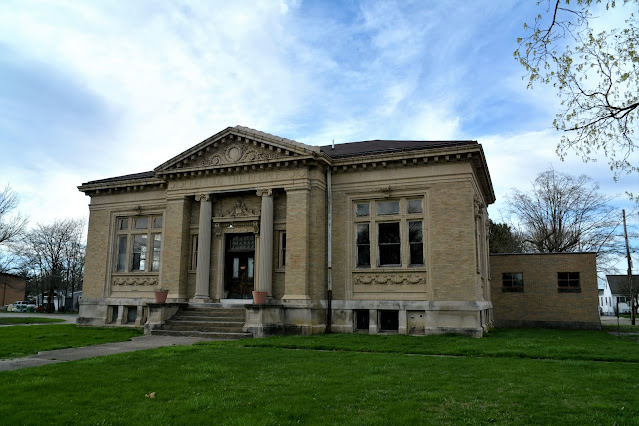
 Xenia Carnegie Library, Xenia, Ohio. The library movement in Xenia truly began when eight women who were graduates of Xenia College formed the Tuesday Club on August 20, 1878. The intentions of the club were for members to prepare literary papers and discuss literature, activities that would require access to a library. By 1902, the Young Women’s Library Association had learned about Carnegie’s library building program and decided to apply for a grant. Louisa Lackey and Diana Roberts donated a 200 x 165 foot lot, part of their estate, for the site of the library building. That same year, James Bertram, private secretary to Andrew Carnegie, in a handwritten note, granted the organization $20,000 for a library building. The architect William Kauffman, the nephew of Louisa Lackey and Diana Roberts donated his services in the design of the library. The foundation work on the library began in the fall of 1903, with construction continuing through the following spring. On July 22, 1904, the cornerstone of the library was laid. Construction of the building was completed in 1904, and in June 1905, the ladies requested and were granted an additional $3,500 for library furnishings. The Xenia Carnegie Library’s official public opening occurred on June 26, 1906. The Carnegie building was closed to the public in 1978, when the newer, larger facility opened. There are now plans in turning the old library into a restaurant. The Xenia Carnegie Library is one of 104 Carnegie libraries that were built in Ohio. Architectural Style-Classical Revival. Posted to the National Register of Historic Places on February 25, 2015. GPS: 39.68781°N, -83.92639°W.