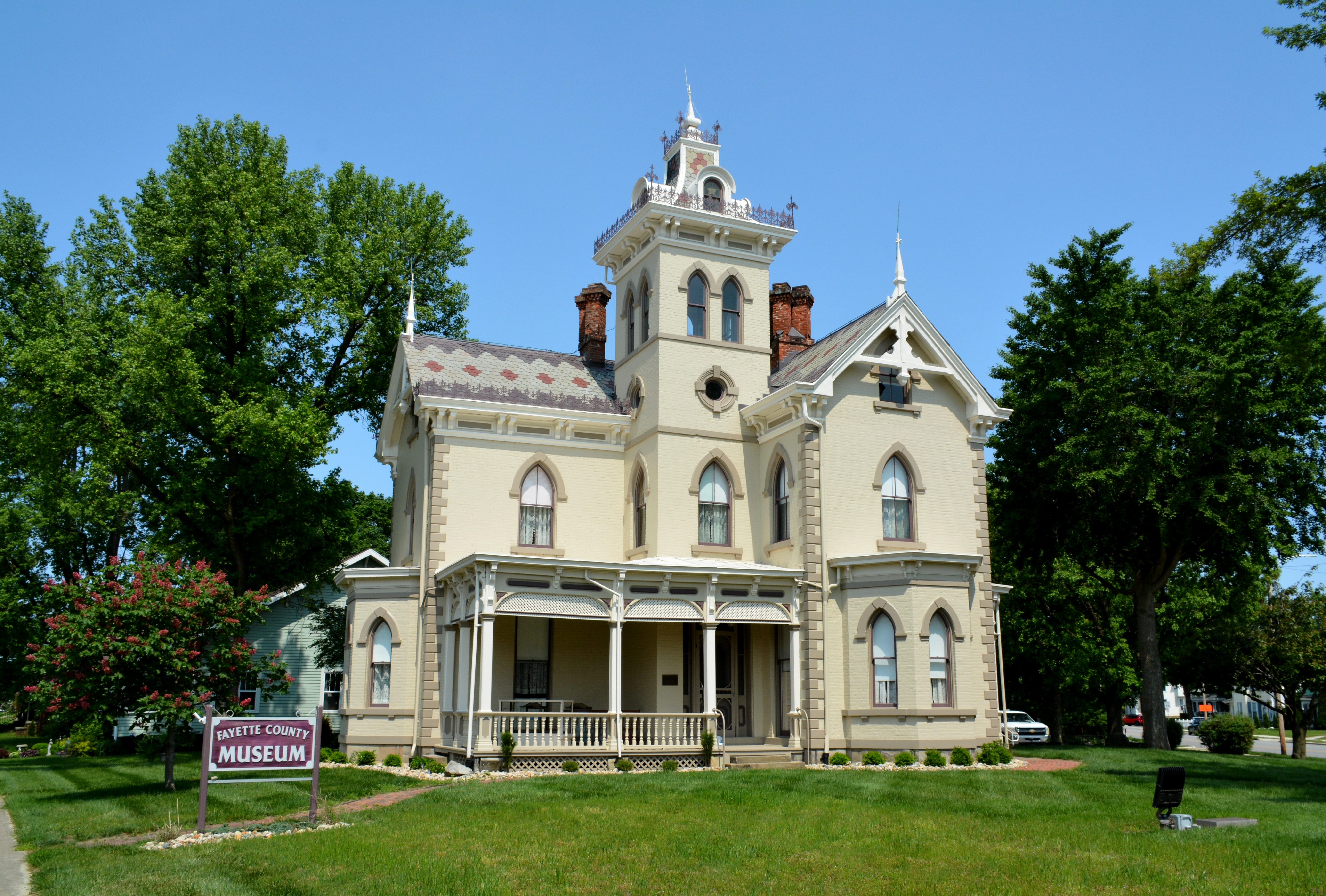
The Morris Sharp House is a historic residence in the city of Washington Court House, Ohio. The house was built for Morris in 1875 in an Italianate architectural style. Morris Sharp was born at Aberdeen, Ohio, in 1838, and with his family, he moved to Jamestown in 1851 before settling in Washington Court House. The Sharps moved temporarily to Covington, Kentucky, and Morris worked for a bank there. In 1873, the Sharps moved back to Washington Court House, and Morris joined the Merchants' and Traders Bank as a cashier. Soon, he organized his own bank, the Commercial Bank, and made himself president. He rapidly became one of the foremost citizens of his adopted city because of his unusual business ability, and until his death in early 1905, he was actively engaged in the management of extensive banking interests and extensive agricultural tracts. In 1958, the Fayette County Historical Society purchased the Morris Sharp House, and seven years later, the property was reopened as the Fayette County Museum. It remains in use as a museum to the present. Posted to the National Register of Historic Places on January 21, 1974. GPS: 39.53904°N, -83.43495°W.
Friday, May 19, 2023
Tuesday, May 16, 2023
William H. McGuffey House - Oxford, Ohio
The William H. McGuffey House is a historic house on the campus of Miami University in Oxford, Ohio. The house was designed and built by McGuffey in 1832-1833, then a professor at Miami University. William Holmes McGuffey (1800–1873) had an abiding interest in public education, and it is here that he began to produce and publish the McGuffey Readers, a series of graded instructional texts. These were hugely popular, selling millions of copies nationwide, and were used by schools as instructional texts into the 20th century. In this house, he compiled the First, Second, Third, and Fourth Readers. These and subsequent texts were estimated to have sold more than 122,000,000 copies. McGuffey only lived here until 1836, when he moved to Athens. There in Athens, he was elected the president of Ohio University on September 17, 1939. He held this position until 1843.
The house has seen various alterations since the McGuffeys lived there. The main entrance was located on the east side, and now the northside is used for the main entrance. Moreover, the porch located on the second floor on the east side of the house was open, and now it has been enclosed. In 1855, a two-story wing containing a room on each level was added to the west side of the house. Posted to the National Register of Historic Places on October 15, 1966. GPS: 39.50709°N, -84.73593°W.
Camden City Hall and Opera House - Camden, Ohio
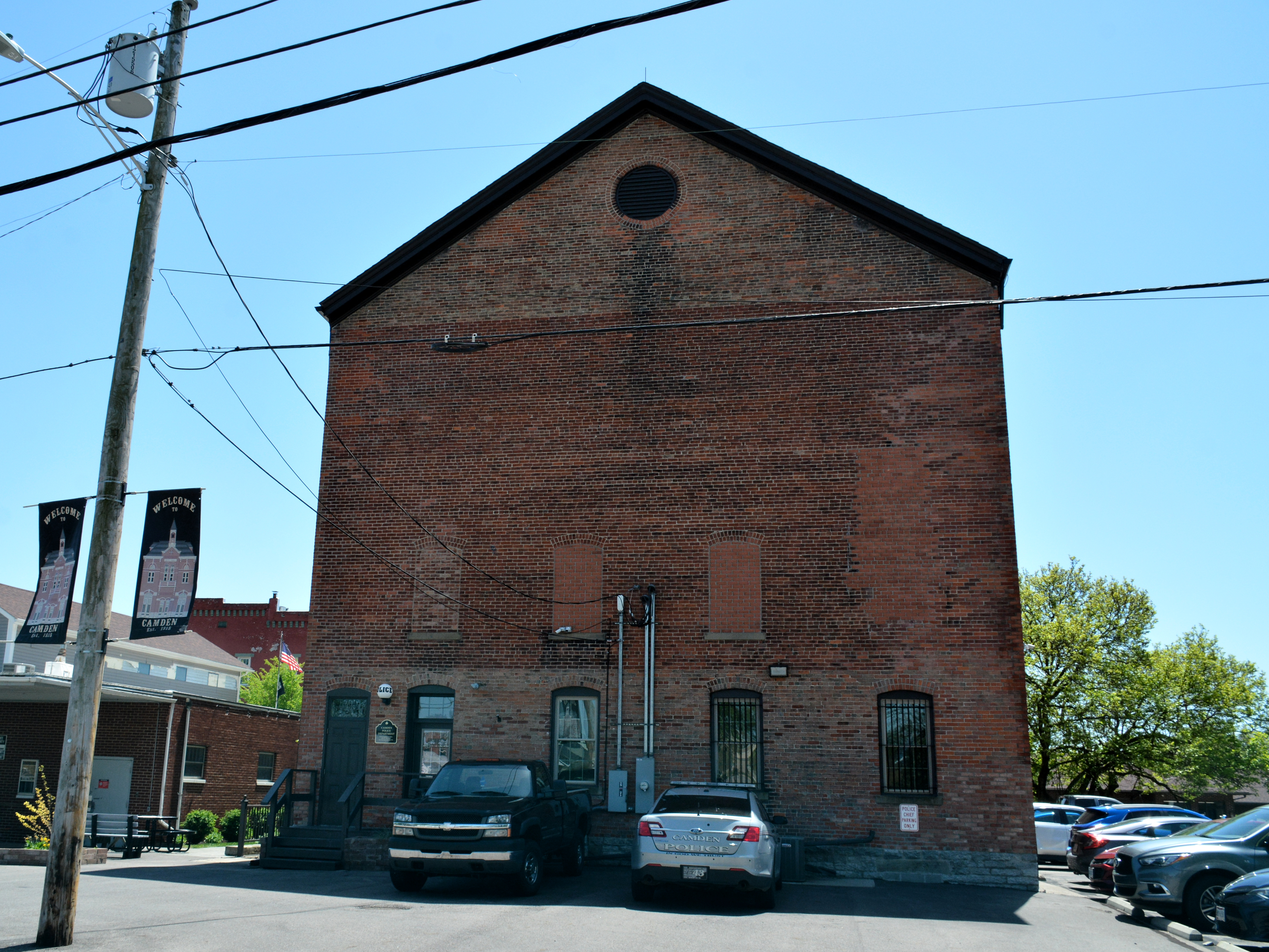
Camden’s Town Hall and Opera House, in Camden, Ohio, was built in 1889 for about $15,000 and opened with an opera performance on the night of May 11th. Throughout the next several years, the building would house the town offices, police department, a jail, and the fire department downstairs, and a stage, auditorium and activity area upstairs. The southwest corner of the building's first floor was occupied by Camden's volunteer fire department from 1895 until 1970. In back of the garage was a room that was originally used as the constable's office (police). Next to it was the jail, a room having four barred windows. Architect/Builder-Lloyd & Hewitt, Oxford, Ohio Contractors. Architectural Style - Late Victorian/Romanesque. Posted to the National Register of Historic Places on February 12, 1998. GPS: 39.62925°N, -84.64941°W.
Thursday, May 11, 2023
John B. Tytus House - Middletown, Ohio
The John B. Tytus House is a historic house in Middletown, Ohio. Built in 1865, it was the home of John Butler Tytus (1875-1944). It is a three-story masonry structure, built out of red brick. It has a stylistically eclectic set of architectural features that includes rounded arches in the Romanesque style, half-timbered gable ends in the Tudor Revival style, and an eyebrow dormer.
After graduating from Yale in 1897, Tytus worked for a short time in his father's paper mill, then in a bridge construction company in Dayton, Ohio. On a visit to the American Rolling Mill (later Armco), Tytus noticed the laborious hand processes involved in making a sheet of strip steel. He was soon employed by Armco, here he developed skills as an engineer and learned the manufacturing process well. Observing that efficiencies of manufacturing could be realized by being able to continuous feed hot steel through a rolling process, he set about to create such a process in 1921. By 1924 his process was sufficiently developed that the company built a new plant implementing it. The plant was an immediate success, and the process was soon widely adopted by other steelmakers. Tytus became a vice-president of Armco and received that company's Distinguished Service Award in 1926, the f i r s t person awarded it for something other than heroism or lifesaving. In 1935, the American Iron and Steel Institute presented Tytus with the Gary Memorial Award, the highest honor in industry, for his outstanding achievements.
House was posted to the National Register of Historic Places on May 27, 1975. GPS: 39.51286°N, -84.40891°W.
After graduating from Yale in 1897, Tytus worked for a short time in his father's paper mill, then in a bridge construction company in Dayton, Ohio. On a visit to the American Rolling Mill (later Armco), Tytus noticed the laborious hand processes involved in making a sheet of strip steel. He was soon employed by Armco, here he developed skills as an engineer and learned the manufacturing process well. Observing that efficiencies of manufacturing could be realized by being able to continuous feed hot steel through a rolling process, he set about to create such a process in 1921. By 1924 his process was sufficiently developed that the company built a new plant implementing it. The plant was an immediate success, and the process was soon widely adopted by other steelmakers. Tytus became a vice-president of Armco and received that company's Distinguished Service Award in 1926, the f i r s t person awarded it for something other than heroism or lifesaving. In 1935, the American Iron and Steel Institute presented Tytus with the Gary Memorial Award, the highest honor in industry, for his outstanding achievements.
House was posted to the National Register of Historic Places on May 27, 1975. GPS: 39.51286°N, -84.40891°W.
Subscribe to:
Posts (Atom)